Every inquiry to a shaker manufacturer looks similar from the outside: you send an email, get a quote, and place an order.
The problem arises when the samples look different than in the photos, safety documents are missing, and the delivery date is pushed back
by a month. Choosing the wrong supplier is not just lost money; it is primarily lost time and a damaged brand reputation.
This article guides you through the entire process: from comparing Polish and foreign shaker manufacturers, through required certificates and material selection, to preparing a production brief that will allow you to collect comparable offers without repeatedly clarifying details. The examples refer to the realities of the EU market in 2026, including the experiences of companies like ShakerX, a Polish manufacturer of
promotional shakers with certified food-grade materials and pre-production visualization.
What will you find in the article?
- Polish or foreign shaker manufacturers: how to start comparing
- Certificates that a manufacturer of printed shakers must have
- How to verify documentation before purchasing
- Plastic or stainless steel: which material to choose for your brand
- Stainless steel shakers: durability and premium
- How material affects personalization and print durability
- Shaker personalization techniques: what determines print durability
- 360° print on shakers: when is it worth choosing
- Pre-production visualization: why it’s a standard, not a bonus
- MOQ and prices of printed shakers: what to expect in 2026
- How to prepare a production brief and ask for the right offer
- Summary: how to choose a shaker manufacturer for your brand
Polish or foreign shaker manufacturers: how to start comparing
Where are most shakers for the European market produced?
Many catalog models available in European shaker wholesalers come from Asian
factories that work on a large scale and offer a wide selection of standard molds. However, a growing number of
European brands are looking for local suppliers for very specific reasons: delivery time,
direct communication, and easier verification of compliance with EU law.
Advantages of working with a Polish shaker manufacturer.
A Polish company speaks Polish, operates in the same time zone, and is subject to the same EU regulations
that apply to your market. You can receive a sample within a few business days instead of waiting
for weeks for a shipment from Asia. Certificates are issued in the context of EU realities, which facilitates their verification and
any questions to the supplier. ShakerX, as one of the Polish manufacturers of promotional shakers,
declares a short lead time and documentation compliant with EU food standards; it is worth verifying the
details directly with the company.
When can a foreign manufacturer be a better choice?
For very large volumes, on the order of 5,000 units or more, an Asian supplier may offer a lower
unit price and a wider selection of standard molds. However, to this price, one must add sea
transport, customs duties, the risk of delays, and the cost of potentially adapting documentation to EU requirements.
The lower the volume, the less competitive Asian prices are after summing up all real costs,
which is why for smaller series, a local shaker wholesaler or European supplier often proves to be
more cost-effective.
Certificates that a manufacturer of printed shakers must have
Compliance with EU 1935/2004 and good manufacturing practices
Regulation (EC) No 1935/2004 is the basic EU legal requirement for any product intended to
come into contact with food. A shaker manufacturer should have a declaration of compliance and migration test reports for the plastic, dyes, seals, and cap. Regulation (EC) No 2023/2006 on good
manufacturing practice (GMP) goes further: it requires control of the production process, not just the materials themselves.
If a shaker is to reach a customer with a supplement inside, both documents are mandatory.
Detailed guidelines regarding materials and articles intended to come into contact with food
can be found on the page for materials and articles intended to come into contact with food.
LFGB, PZH, BPA-free, and FDA: what to check depending on the market
LFGB is a demanding testing standard for food-contact products, often expected by
recipients in Germany and all of Western Europe. PZH is a Polish confirmation of food contact safety and a specific argument when talking to recipients on the Polish market; before establishing cooperation, it is worth asking the supplier for a current document. The BPA-free declaration means the absence of bisphenol A in the material and is an important marketing asset, but it does not replace migration tests. For the US market, there is the issue of compliance with FDA requirements for food-contact materials.
How to verify documentation before purchasing
Ask for a declaration of compliance for food contact, migration test reports, and information about the
materials used in production. A reliable manufacturer of plastic or steel shakers will provide
basic documents upon request, although detailed laboratory reports may involve an
additional cost. If the supplier refuses, delays the topic, or claims that documents are in
preparation, this is a serious warning sign, especially when the product is to reach a user with protein powder.
Plastic or stainless steel: which material to choose for your brand
Plastic shakers: for whom and when
Plastic, especially PP and Tritan, is lightweight, cheaper to produce, and much easier to fully personalize
in terms of color. For supplement brands, gyms, and promotional gadgets, this is a natural choice. With
certified materials, plastic is completely safe for contact with food and supplements.
Typical wholesale prices in the EU for standard orders are 2 – 3.00 EUR per piece, depending
on the volume and degree of personalization. If you also care about the environmental aspect, useful data on
how long plastic takes to decompose will help in the discussion about material choice. When making a decision, it is also worth checking practical guides, e.g., how to choose a shaker, which describe the differences between models and applications.
Stainless steel shakers: durability and premium
Manufacturers of bar shakers and the premium wellness segment opt for stainless steel due to its
durability, resistance to mechanical damage, and professional appearance. Steel better maintains the
temperature of the drink and is more resistant to intensive use, which is appreciated by bartenders and companies in the
premium fitness sector. The unit cost is higher and is usually 5-8.00 EUR for typical
wholesale orders in the EU, and minimum volumes are usually higher than for plastic.
How material affects personalization and print durability
On plastic, you can achieve full 360-degree coverage with a wide range of colors, which provides maximum
advertising space. On steel, laser engraving and spot screen printing dominate, which offer a smaller
print area but very high marking durability. The material decision and the print technique decision should go hand in hand; one directly limits or opens up the branding possibilities of the other.
Shaker personalization techniques: what determines print durability
Screen printing, pad printing, and laser engraving: a brief comparison
Screen printing is economical for volumes over several hundred pieces, usually available in the range of 1-4 colors, and durable when properly fixed. Pad printing works well on curved surfaces and for precise, small logos; it is a method often better than screen printing for short series under 200 pieces. Laser engraving offers the highest durability of all methods because the pattern is applied by changing the surface of the material, not by a layer of paint. It is particularly popular for steel and wherever the longevity of the marking counts. More about available marking and printing methods can be read in guides on printing techniques and marking methods.
360° print on shakers: when is it worth choosing
Full wrap-around, printing covering the entire circumference of the shaker, provides maximum
advertising space and distinguishes the product from standard shakers with panel printing. This is particularly valuable for
brands that want to make the shaker a carrier of visual identity, not just a container with a logo in the
corner. This method is used by some plastic shaker manufacturers, offering full coverage of the
surface; ShakerX is among the companies that offer it; details should be confirmed directly.
The cost-effectiveness of this method increases with medium and large volumes.
Pre-production visualization: why it's a standard, not a bonus
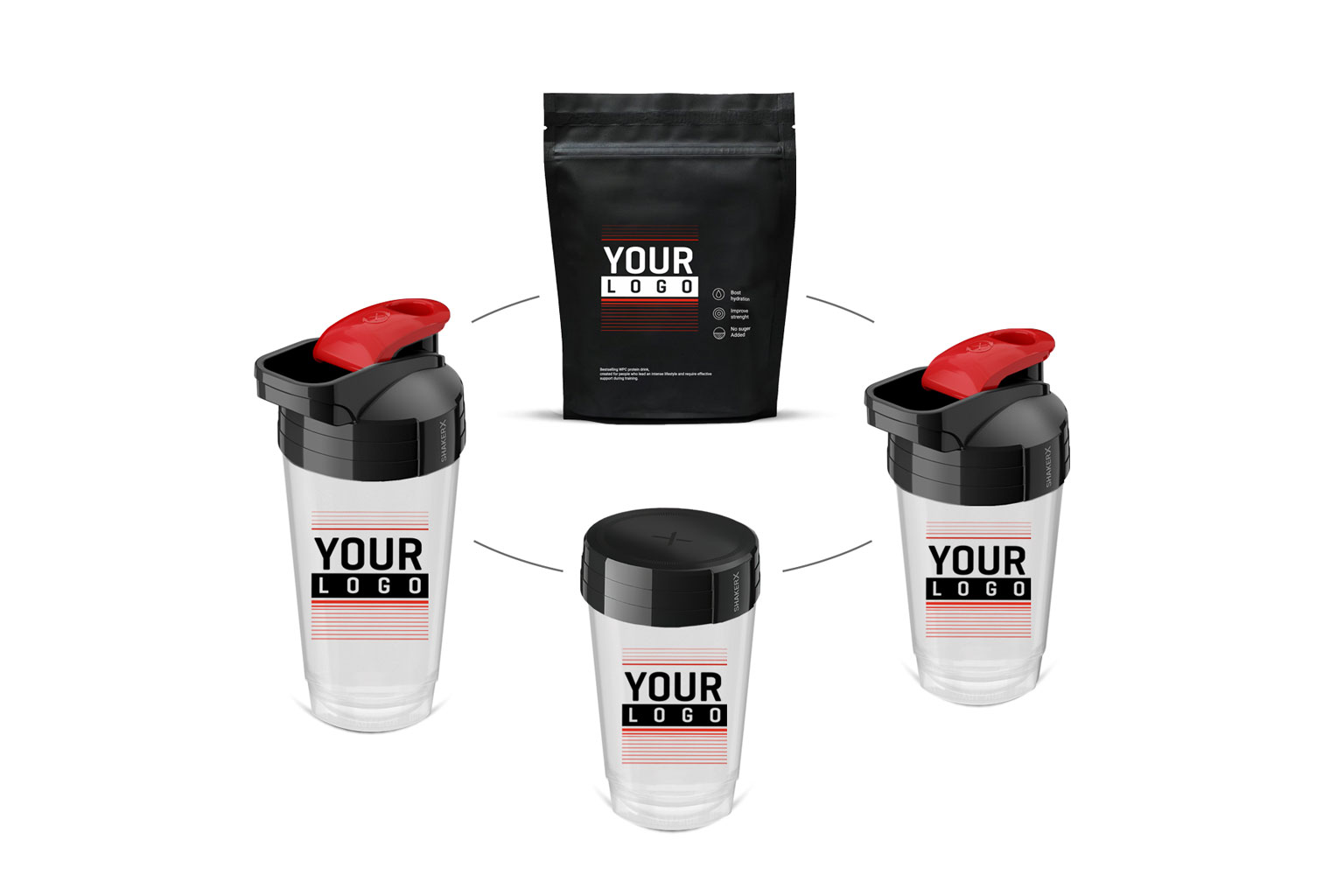
A reliable company should provide a mockup before starting production. This protects both parties from
costly mistakes. ShakerX declares free visualization before the start of production; this is a good
example of a standard that is worth requiring from every supplier of printed shakers. Suppliers
who charge for visualization or do not offer it at all create a real risk of design errors that only come to light upon receipt of the finished batch.
MOQ and prices of printed shakers: what to expect in 2026
Minimum production volumes by material
For plastic shakers, the minimum order is usually from 100 to 500 pieces for simple
models; with extensive personalization, the threshold is higher. For stainless steel shakers, the MOQ
for shakers is usually in the range of 300 to 1,000 pieces. A local supplier is usually more
flexible in negotiations than an Asian partner, where the entry threshold is higher and every change
extends communication by subsequent days.
How volume affects unit price
The principle is simple: the higher the volume, the lower the unit price. When comparing offers, remember
that price ranges depend on the material; plastic and steel are completely different starting points. The number of print
colors, marking technique, and degree of customization increase the base price, so it is worth establishing these
parameters before you compare offers from different suppliers.
Hidden costs worth remembering
When importing from outside the EU, sea transport, customs duties, and potential clearance fees must be added to the unit price.
In addition, there are costs for matrices or molds for new designs and fees for design or
visualization if the manufacturer does not include them. Already at the inquiry stage, it is worth asking directly:
what is included in the given unit price and what will be invoiced separately?
How to prepare a production brief and ask for the right offer
What a good brief for a shaker manufacturer should contain
A complete brief allows you to avoid repeated clarifications and enables the comparison of offers from several
suppliers under the same conditions. Before sending an inquiry, collect the following information:
- target volume and potential quantity thresholds (e.g., 300, 500, 1000 pcs.)
- material and capacity of the shaker (PP/Tritan plastic, steel, 400 ml, 700 ml)
- intended use of the product: supplements, personalized promotional shakers
- required certificates (EU 1935/2004, LFGB, PZH, BPA-free, FDA)
- preferred print technique, number of colors, and graphic design or guidelines for visualization
- expected delivery date
Samples and prototypes: when and how to ask for them
Before starting serial production, it is worth asking for at least a digital visualization with a
real design. For orders over 500 pieces, many serious manufacturers offer a
physical sample, which allows you to verify the print quality, seal tightness, and general quality of
workmanship. Do not treat giving up on a sample as a saving: the cost of fixing an error in the entire batch is
many times higher than the cost of a courier shipment with a sample.
Control questions before signing a contract
Before you place an order, ask the supplier a few specific questions. The answers will quickly show whether
you are dealing with an experienced partner. It is worth asking:
- Do you have an EU 1935/2004 declaration of compliance for all elements of the shaker?
- What is the lead time from design approval to shipment?
- Is the visualization included in the price?
- Are design changes possible after the mockup stage?
- What are the complaint conditions in case of non-compliance of the print with the visualization?
Summary: how to choose a shaker manufacturer for your brand
Choosing a shaker supplier comes down to a few key decisions. The first is the location of the
manufacturer and its impact on logistics and communication. The second is the completeness of the certification
documentation; without it, there is no talk of a safe product. The third is the choice of material and printing
technique adapted to the brand’s budget and needs. The fourth is the real MOQ and the full cost of the order
after adding transport and any additional fees. Each of these points is worth verifying
before signing a contract, not after receiving the invoice.
If you are looking for a Polish manufacturer of shakers with certified food-grade materials, 360-degree
printing, and a free mockup before production, check out the ShakerX offer. It is a good starting point,
which will allow you to see what a well-prepared proposal looks like and what you can require from
other suppliers.