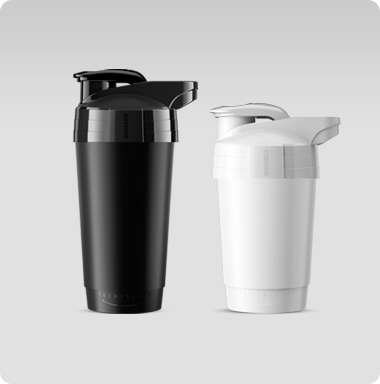
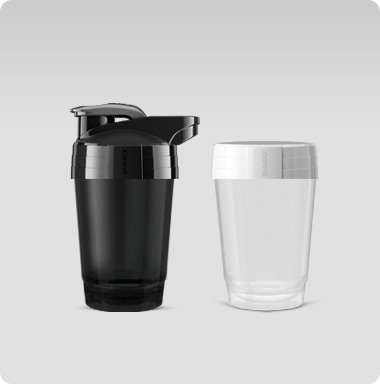
Imagine this: you ordered 300 logo-branded shakers for the opening of a new club, you hand them out to members for the first few weeks, and after a month, complaints start coming back to the reception. The cap leaks, protein clumps in the corners of the bottom, the product looks bad. Your logo is on that shaker — it’s your brand that gets the rating, not the manufacturer who made it.
This guide goes through the things that actually decide this: material, sealing, mixing technology, and documentation. Not through marketing on the supplier’s website, but through specific design solutions that are worth asking about.
What will you find in the article?
- Material: the first and most important decision
- Leaktightness comes from the precision of the cap, not from thick plastic
- Mixing technology and user experience
- Documentation: what to check before you place an order
- Printing: the surface determines visibility
- Checklist: six questions for every supplier
- Summary
Material: the first and most important decision
The material determines whether the product will return from the gym in one piece after a year of use — and whether it will still look like a brand calling card, rather than a worn-out gadget.
Tritan is a copolyester, considered the standard in the premium segment. It is characterized by higher impact resistance than standard polypropylene, so it handles drops on hard surfaces better. It retains its shape and transparency in the dishwasher, is taste and odor neutral, and is BPA-free.
Polypropylene (PP) is lighter, cheaper, and chemically resistant. It works well for everyday sports use, but upon a violent impact — depending on the grade, wall thickness, and additives — it can crack or permanently whiten the surface.
Stainless steel wins with mechanical resistance and premium aesthetics, but carries three compromises for promotional shakers: higher weight, higher unit cost, and more difficult printing on a rounded metal surface. It makes sense as a corporate gadget in small quantities — not as a product for 300 competition participants.
Let’s be clear: a BPA-free shaker is the minimum today, not a differentiator. Every self-respecting manufacturer offers materials without bisphenol A. The question worth asking is not “is it BPA-free”, but “what specific material is it made of and what is the wall thickness”.
The difference between good and bad material is visible in the wall thickness and in the clear material marking on the bottom of the container. Look for markings in the recycling triangle.
Leaktightness comes from the precision of the cap, not from thick plastic
You can have the most expensive material on the market — if the cap is poorly fitted, the shaker will leak in your backpack. Leaktightness is the result of the closure design and production tolerances, not wall thickness.
Thread precision and tolerances. Leaktightness is determined by how accurately the cap fits the body. A precisely made thread with even pressure around the entire circumference closes the container securely and repeatably — piece after piece. In cheaper solutions, looser tolerances mean that leaktightness can vary between units, and that is a real problem when ordering several hundred shakers.
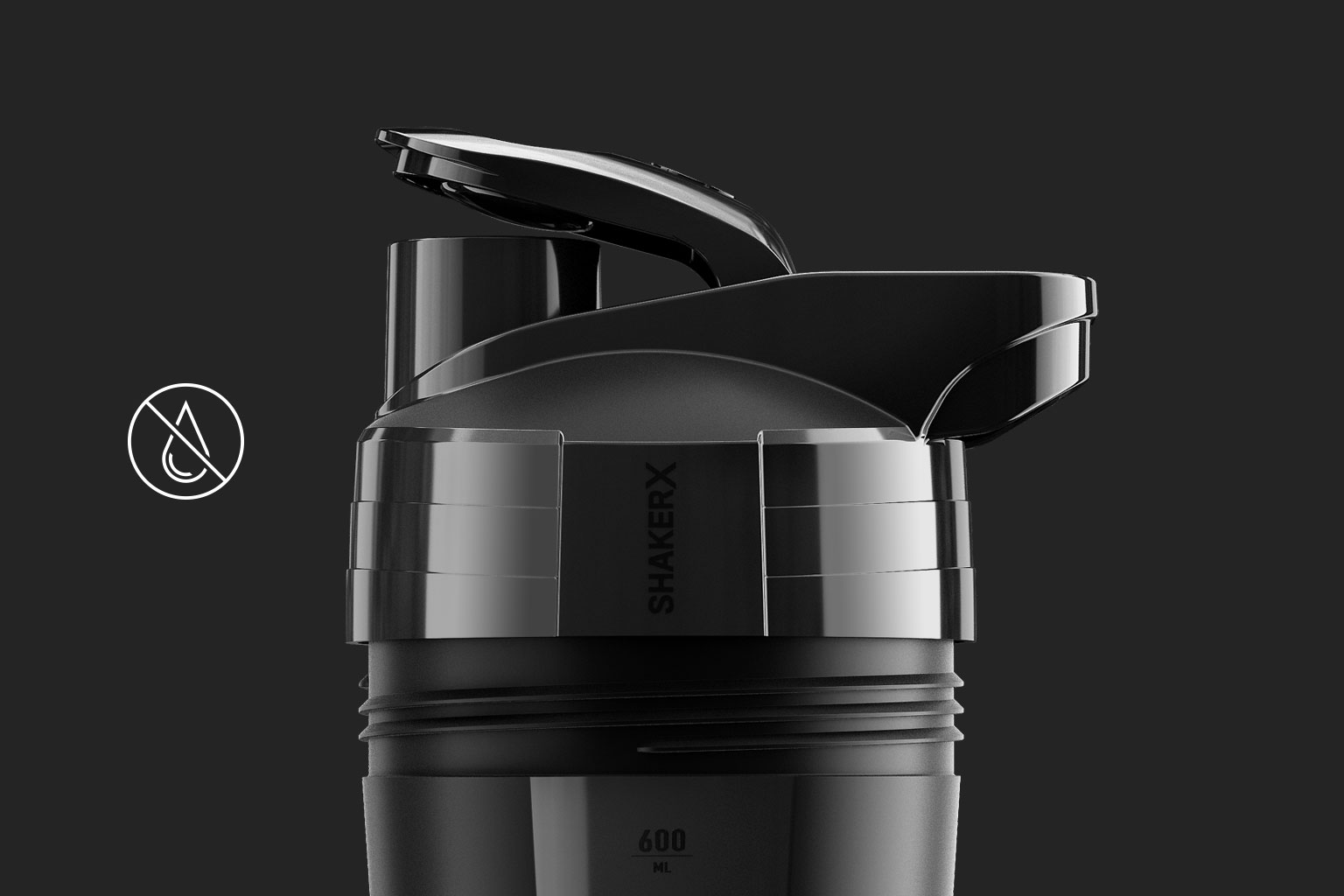
Snap-on vs. screw-on. A snap-on cap provides quick access to the inside, which users appreciate during training, but its leaktightness depends heavily on spring strength and geometry, which wear out over time. In transport — especially when the shaker also serves as a meal container — a well-fitted screw thread provides a more reliable closure.
For products with two interchangeable caps, additionally check if both close just as securely.
How to verify this before ordering several hundred pieces: ask for a sample. Fill the shaker with water to 70–80% capacity, screw it on tightly, and turn it upside down on a paper towel for 60 seconds. Then shake vigorously for 15 seconds in different directions — this is more realistic than just standing it upside down, because it simulates use during training.
Check the leaktightness after several openings and closings, not just the first time. The cap mechanism usually fails precisely after several uses.
This is a test worth doing with every supplier before a large order. A manufacturer who does not want to send a sample for testing leaves all the risk on your side.
Mixing technology and user experience
This is an element that those ordering gadgets often don’t think about at all. A mistake – because the user’s experience with the product is a direct message about the brand whose logo is on it.
Mixing ball works, but it makes noise with every shake, can scratch the inside of the shaker, and regularly falls out when washing. In a logo-branded shaker, it carries an additional risk: with prolonged use, it mechanically damages the inner surface, which worsens the aesthetics and hygiene of the product.
Ball-free solutions replace the ball with shape: rounded bottom corners, a smooth inner surface, and no dead zones where powder clumps. This is an approach based on geometry, not on additional moving parts.
Circle Technology in our shakers is based on exactly this: the rounded bottom and smooth inner surface make the liquid circulate without dead zones, and mixing takes place without a strainer and without a ball. Fewer elements mean faster washing and no parts that can be lost down the sink.
For you as the purchaser, this is a practical argument: a product that works better on a daily basis builds positive associations with your logo. A user satisfied with the functionality looks more favorably at that logo.
Documentation: what to check before you place an order
Food contact approval certificate and compliance with PPWR, confirm that the material has passed laboratory tests: chemical composition analysis, food migration tests, and taste and odor impact assessment. This is a completely different category than the “BPA-free” slogan on a store’s website – that is a declaration, this is a documented test result.
Our shakers are produced using material with food contact certification, and we provide the document with the order.
You can find various markings on products: “BPA-free” logotype, European standard numbers, references to FDA regulations. Each says something, but none replaces a formal food contact certificate. Before ordering, ask the supplier for a scan of the current document, not an FAQ page. If they cannot show it, you know what to expect from the product.
Printing: the surface determines visibility
Every person holding the shaker sees the print. It is worth understanding what gives the greatest brand exposure.
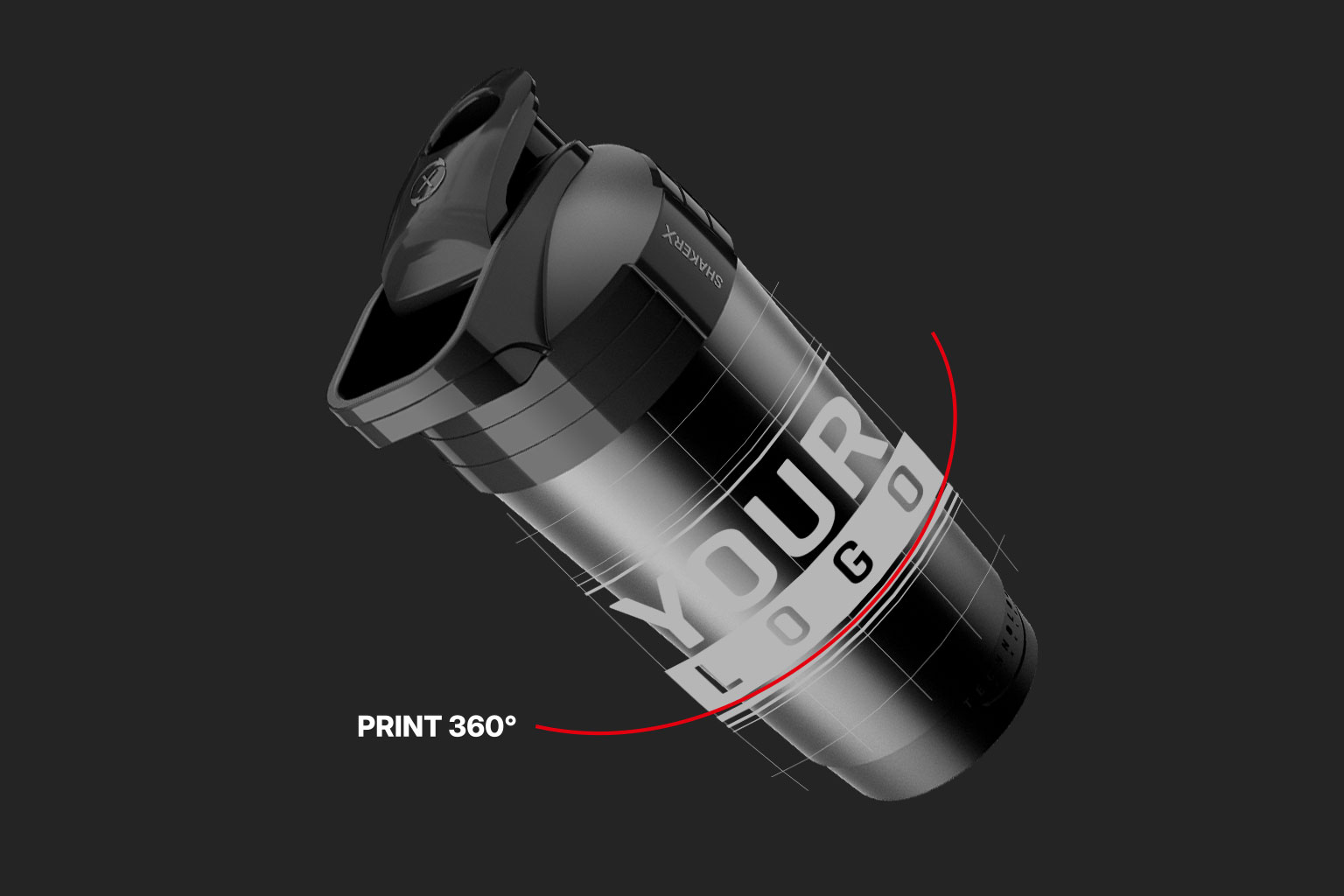
Standard marking on one or two sides gives limited advertising space. 360° printing covers the entire side surface, so the logo and graphics are visible regardless of how the product lies on the counter, how it is held in the hand, and how it hangs from a backpack mesh.
For us, 360° printing is not a premium option – the price depends solely on the number of colors, not on the size of the graphic. A full circumference costs the same as a small logo on the side.
The substrate matters here. A smooth, cylindrical surface without seams and ribbing is a condition for the graphic to lie evenly around the entire circumference – our shakers are designed for full coverage from the design stage.
Checklist: six questions for every supplier
Not as a bureaucratic form, but as a tool that separates products that meet the criteria from those that only look good in an offer folder in five minutes.
1. Is the product approved for food contact or does it have another food contact certificate?
Ask for a scan, not a verbal declaration. The document should be current and issued for a specific product or material.
2. How does the cap close and is the closure repeatable between units?
Find out what the leaktightness is based on and whether it works just as reliably with both caps if the product is a 2-in-1 model. Ask for a sample for a physical test.
3. What material is the body made of?
Ask about the specific material: Tritan, PP, HDPE. Check the marking on the bottom. A general answer “safe plastic” is not enough.
4. What does the mixing technology look like – ball, strainer, or ball-free solution?
Ball-free ones are easier to maintain and do not risk damaging the interior. This is a practical advantage for the user, who will transfer the association with the product to your brand.
5. What does the print price depend on – the size of the area or the number of colors?
This question quickly shows how much you will actually pay for full brand exposure.
6. Is the visualization before ordering free and what are the minimum quantities?
A free preview in a reasonable time is standard for B2B orders, not a premium service.
Our answers: PPWR compliance for inspection, sample for self-testing of leaktightness, Circle Technology without a ball or strainer, 360° printing priced by the number of colors, free visualization in 24 hours, MOQ from one carton – 60 pieces for 400 ml, 56 for 700 ml. Compare this with what others offer.
Summary
The durability and leaktightness of a personalized shaker are not a matter of chance. They result from specific design decisions: choice of material, cap precision, bottom geometry, documentation, and printing method.
A supplier who cannot answer the six questions from the list above will likely not meet your expectations when the product first comes into daily use.
A shaker with your logo reaches the recipient’s hands dozens of times a week and makes an impression about your brand every time. It is worth ensuring that this impression is a good one.
Write for a free visualization and ask for a sample – check the product before you decide on the quantity.